Follow us

Search
For health professionalsContact usPress Enter to search. For products, try the shop filter.
 (08) 6110 0570
 admin@pdchealthhub.com.au
Press Enter to search. For products, try the shop filter.
(08) 6110 0570admin@pdchealthhub.com.auPain at the back of the heel is often Achilles tendinopathy, which responds best to a progressive strengthening program over weeks to months. A sudden snap with weak push off needs urgent assessment.
Achilles pain is felt at the back of the heel or lower calf, often as soreness and stiffness when walking, running or jumping, and it can be worse at the start of activity or in the morning.1 The most common cause is Achilles tendinopathy (specifically midportion Achilles tendinopathy, affecting the middle of the tendon), where the tendon becomes sore and less tolerant of load.2 Overuse in running and jumping sports, flat feet, unsuitable footwear and excess weight are linked to it, and certain quinolone antibiotics can contribute, so tell your doctor or pharmacist if you develop tendon pain while taking them.3
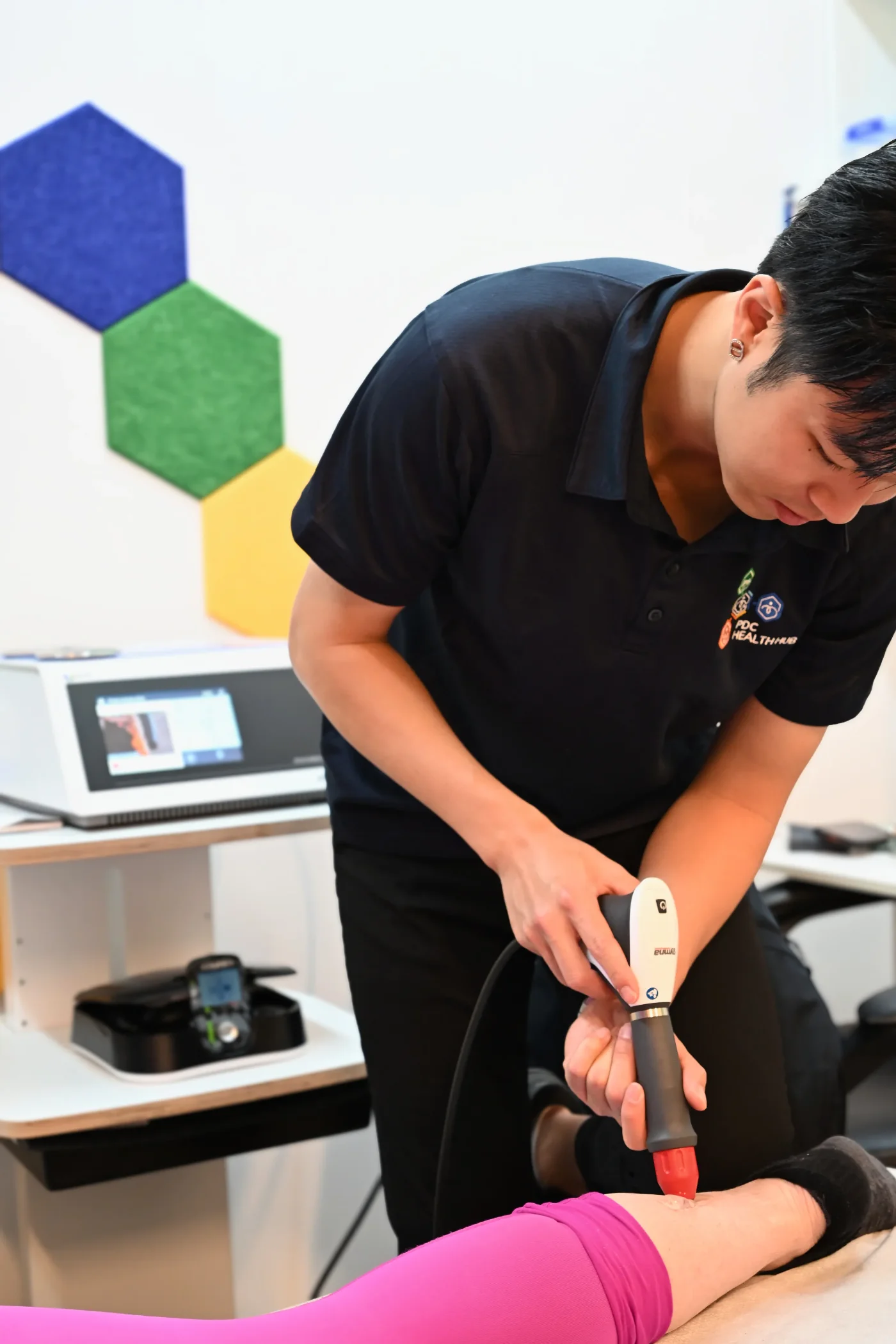
Tendon loading exercise, with loads as high as tolerated and done at least three times a week, is the first-line treatment in the 2024 international physiotherapy guideline.2 Trials of loading programs ran from six weeks to six months, with improvements building over about twelve weeks, so expect weeks to months.2 Manual therapy and dry needling may help alongside exercise, while ultrasound alone and low-level laser are not recommended.2 Shockwave therapy may be considered selectively as an add-on to a loading program, not instead of one. A sudden pop at the back of the ankle with weakness may be a rupture and needs urgent assessment.1
PHOTO NEEDED · Add a Hero Image to this condition in the CMS: a PDC clinician with a client, natural light, no identifiable health information on screen
Symptoms are a guide, not a diagnosis. Your GP confirms the diagnosis; our team helps you manage it day to day.
The teams and services that most often support people with this condition. They work from one shared plan, and one GP referral reaches all of them.
Our care follows the 2024 JOSPT clinical practice guideline for midportion Achilles tendinopathy, alongside Australian public guidance from Healthdirect and Queensland Health.
It varies, and it is usually weeks to months rather than days. Trials of tendon loading programs ran from six weeks to six months, with improvement often building over about twelve weeks. Staying consistent with your program matters more than the first few days.
Complete rest rarely solves it. Guidelines recommend tendon loading exercise as first-line care, while running and jumping may need adjusting. Avoid working through severe pain. We tailor how much load suits your tendon and your sport.
Healthdirect describes a rupture as feeling like a strike to the back of the ankle, sometimes with a popping sound, then weakness or being unable to move the foot downward.<sup>1</sup> Seek urgent medical assessment, at an emergency department if a fracture clinic is not available.<sup>4</sup>
Shockwave therapy is considered selectively and is not part of the first-line loading program. Where it is used, it sits alongside, not instead of, a loading program, and we review whether it is helping.
No referral is needed for private appointments. With a GP Chronic Condition Management Plan, Medicare rebates apply to up to five eligible allied health services a calendar year. Private health extras often cover physiotherapy, and workers compensation may apply if the problem is work related.
Tell us what is going on and we will point you to the right discipline, or to more than one. Most people start with a single appointment and leave with a plan the rest of the team can see.
Or go straight to a service
Phone (08) 6110 0570 · Medicare, NDIS, DVA and private options across our services
For GPs and health professionals
Send an online referral in under two minutes. One referral reaches every discipline at PDC Health Hub.